- Home
- Platform 02 · Food & Foraging
- Harvesting Purple Sea Urchins on the Sonoma Coast for Uni
Harvesting Purple Sea Urchins on the Sonoma Coast for Uni
A foraging expedition with Fork in the Path took a group of roughly 25 to 30 participants to California's Sonoma Coast before sunrise to harvest purple sea urchins — and the prized uni inside them — from Pacific tide pools.
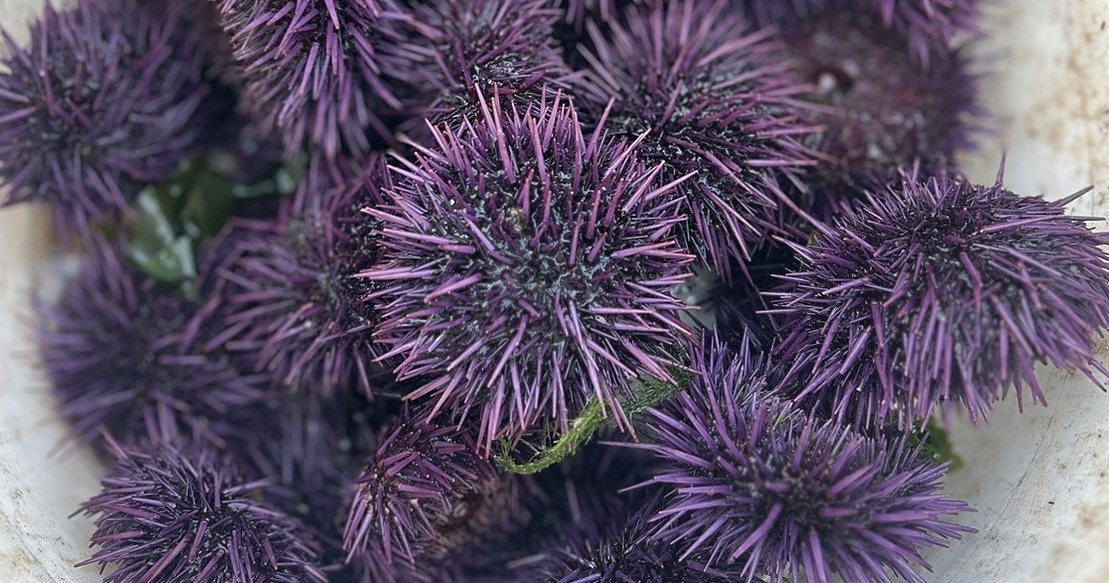
The group — about 25 or 30 people in total — had signed up with Fork in the Path, a company that runs foraging expeditions for mussels, seaweed, mushrooms, acorns, and other edible finds. The draw was not the urchins themselves so much as what they hold inside: uni, a buttery, briny delicacy that participants planned to turn into compound butter or stir into pasta.
Unlike many other sought-after foods, sea urchin foraging carries few ethical complications. The animals are not endangered — quite the reverse — and harvesting them does not disrupt other species. Given the explosion of California's urchin population over the past decade, removing them from mossy rocks actually benefits the state's ecology.
Safety rules and a location promise
After safety instructions — including the reminder not to turn your back on the ocean — and an agreement not to share the exact location on social media or anywhere else, the group made its way down to the beach and waded in. Fork in the Path takes its role as a steward of land and sea seriously. Participants moved cautiously at first, then with increasing enthusiasm, quickly becoming comfortable with one another despite the gray dawn light.
"We're saving California!" said one participant in waders. A psychologist who had driven up from San Diego the day before remarked that the urchins' mouths resemble aliens' rear ends. Up close, the animals' radially symmetrical anatomy is striking, though their spines — contrary to what many expect — feel more like pencil tips and can be handled without gloves.
Participants had one hour to fill 10-gallon buckets with up to 35 urchins each, the daily limit under a state-issued fishing license. With the tide coming in, there was a friendly but informal competition to collect the larger specimens before they were submerged. Care was taken not to harm other intertidal residents, including burnt-orange sea stars and sea anemones.
Uni, kelp forests, and a population crisis
Larger urchins generally contain more uni, which is technically the animals' reproductive organs and the only part of their bodies where calories are stored. Uni is a fixture of San Francisco's high-end Japanese and omakase restaurants, though most of what appears on those menus is the larger red sea urchin sourced from Hokkaido, Japan. The purple variety overrunning California's kelp forests — a habitat and food source for thousands of marine species — is also considered delicious.
Guide Ryn Sullivan noted that in a healthy ecosystem there would be one or two sea urchins per square meter; on some rocks that day, urchins were stacked on top of one another in a dense lavender carpet. The California Department of Fish and Wildlife adjusts its sea-urchin harvesting regulations carefully, mindful of overharvesting. Strictly speaking, Strongylocentrotus purpuratus is not an invasive species — urchins are California natives — but two events in the 2010s sent the coastal ecosystem into disarray: sea star wasting disease nearly wiped out their main predators, and a subsequent marine heatwave known as "The Blob" caused them to reproduce in enormous numbers.
Sullivan explained that the animals can survive even when food is scarce. If they exhaust an area's kelp, individual urchins can retreat to a reef, going dormant for decades until they detect that food has returned. Sullivan is a self-described sea urchin obsessive who became fascinated by the animals after a childhood visit to the Monterey Bay Aquarium. They were living in Santa Cruz when sea star wasting disease spread widely and spent considerable time in the tide pools. A decade later, partly inspired by the video game "Dave the Diver," they transitioned from backpacking guide to forager and outdoor educator. Licensed to dive off reefs and remove up to 1,400 urchins per day, Sullivan nonetheless opposes simply smashing urchins with a hammer, a practice some kelp advocates have adopted. "Urchins get a lot of hate, but I don't like mass-murdering them. They're supposed to be here," Sullivan said.
Cracking open the shells and cooking the catch
Sullivan and colleagues demonstrated how to crack open the shell using the handles of two spoons, clear out the partially digested kelp inside, and extract the five pieces of uni found in each urchin. Mussel shells are described as ideal scooping tools, though the beach on the day of the outing had none. Participants ate some uni on the spot — the process becomes straightforward by the third or fourth attempt — and stored the rest in a cooler with an ice pack. Urchins can survive out of water for up to two days but need to be kept cold and dry, away from melting ice.
Back in San Francisco, the remaining 30 urchins were cleaned over the sink — about an hour's work — and went into a pot of bucatini with garlic, shallots, white wine, and cream.
| Time | Service | Plat |
|---|---|---|
| 09:00 | Urban Foraging Gains Ground as Food Prices and Safety Concerns GrowChristian Science Monitor - CSMonitor.com · 2026-09-10 | 02 |
| 02:38 | Ozarks Foraging Guides and Private Chefs Offering Unique Edible Plant Experiences417 Magazine · 2026-07-31 | 02 |
| 22:22 | Vermont Program Shows Residents How to Forage and Cook Wild FoodsWCAX · 2026-09-22 | 02 |
| 07:00 | Social Media and Local Clubs Are Bringing Foraging to New AudiencesAppalachian Voices · 2026-09-02 | 02 |
| 07:00 | Durango Chef and Forager Finds Edible Plants Growing Along Local TrailsRocky Mountain PBS · 2026-08-03 | 02 |