- Home
- Platform 03 · Nature & Ecology
- Satellite Data Underestimates Carbon Stored in Mature Forests Worldwide
Satellite Data Underestimates Carbon Stored in Mature Forests Worldwide
Carbon accumulation in mature forests across the globe is more widespread than satellite observations currently suggest, according to a body of research published as of mid-2026.
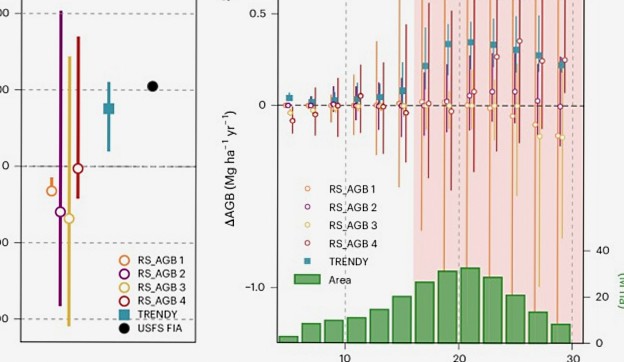
Studies drawing on long-term ground plots, satellite remote sensing, and atmospheric inversions have collectively pointed to a persistent gap between what orbital instruments detect and the actual carbon being sequestered in mature and old-growth forests around the world.
Research published in Nature in 2008 by Luyssaert and colleagues established that old-growth forests function as global carbon sinks, a finding that challenged earlier assumptions. Subsequent work by Pan and colleagues, appearing in Science in 2011 and updated in Nature in 2024, described a large and enduring carbon sink across the world's forests.
Satellite Limitations in Dense Forests
A recurring theme across multiple studies is the difficulty satellites face when measuring biomass in dense or structurally complex forests. Research has documented that L-band synthetic aperture radar backscatter decreases as biomass increases in dense forests, that optical spectral reflectance becomes saturated in high-biomass stands, and that structural complexity biases standard vegetation greenness indices. These technical constraints mean that carbon stocks in mature forests tend to be undercounted by remote sensing approaches.
Work by Mitchard and colleagues published in 2014 found markedly divergent estimates of Amazon forest carbon density when comparing ground-based plots with satellite-derived figures. Studies by Jha and colleagues in 2021 and Araza and colleagues in 2023 further examined the limited ability of current passive satellite data to accurately map aboveground biomass in tropical forests and highlighted disagreements among multiple global biomass change maps.
Ground Plots and Model Estimates
Evidence from long-term ground plots in tropical regions, including work by Phillips and colleagues dating to 1998 and continued through subsequent decades in the Amazon, showed increasing biomass in monitored forest plots. Research by Stephenson and colleagues, published in Nature in 2014, found that the rate of carbon accumulation in trees increases continuously with tree size, reinforcing the significance of large, mature trees as carbon stores.
Dynamic global vegetation models assessed through projects such as TRENDY, along with atmospheric CO2 inversion ensembles, have been used alongside satellite observations to estimate terrestrial carbon budgets, though differences among methods remain substantial. A 2025 study by Bar-On and colleagues in Science found that recent gains in global terrestrial carbon stocks are stored mostly in nonliving pools, adding further complexity to how forest carbon accumulation is attributed and measured.
The Global Carbon Budget 2025, published in Earth System Science Data, and related analyses continue to highlight uncertainty in land carbon sink estimates, with mature forests representing one of the largest sources of that uncertainty.
| Time | Service | Plat |
|---|---|---|
| 07:00 | Global butterfly ranges shifting dramatically in response to climate changeNature · 2026-08-05 | 03 |
| 07:00 | One in Ten Butterfly Species Has Shifted Range as Climate WarmsEurekAlert! Science News Releases · 2026-08-05 | 03 |
| 07:00 | Resource–Trait Coordination Under Multiple Global Change Factors Shapes Ecosystem StabilityNature · 2026-09-14 | 03 |
| 07:00 | Common Birds and Butterflies Forecast to Decline Across Europe Despite Conservation PoliciesNature · 2026-07-31 | 03 |
| 07:00 | Non-Native Plant Mycorrhizal Strategies Shift Across Biomes and Disturbance LevelsNature · 2026-08-17 | 03 |