- Home
- Platform 03 · Nature & Ecology
- Global butterfly ranges shifting dramatically in response to climate change
Global butterfly ranges shifting dramatically in response to climate change
A growing body of scientific literature documents extensive climate-driven range shifts in butterfly species around the world, with studies tracking changes in geographical distributions across continents, elevations, and latitudes.
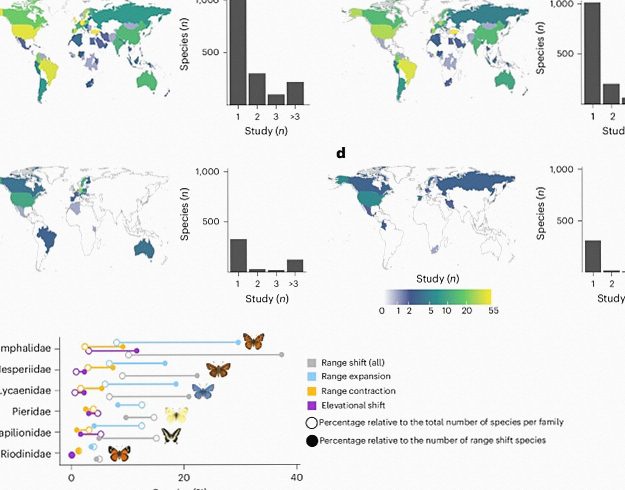
Multiple research teams have recorded poleward and upslope movements in butterfly populations linked to regional warming. A foundational study by Parmesan et al., published in Nature in 1999, identified poleward shifts in the geographical ranges of butterfly species associated with regional warming. A subsequent study by Chen et al. in Science in 2011 found rapid range shifts in species associated with high levels of climate warming.
Devictor et al., writing in Nature Climate Change in 2012, identified differences in what they termed climatic debts between birds and butterflies at a continental scale. Separately, Hällfors et al., publishing in Evolutionary Letters in 2024, concluded that recent range shifts in moths, butterflies, and birds are driven by the breadth of their climatic niche.
Elevation, tropics, and regional findings
Freeman et al. in Global Ecology and Biogeography in 2018 examined expanding, shifting, and shrinking elevational distributions under global warming. Chan et al., in Nature in 2024, analysed climate velocities and species tracking specifically in global mountain regions. Vitasse et al., in Biological Reviews in 2021, documented phenological and elevational shifts of plants, animals, and fungi under climate change in the European Alps.
In the tropics, Chowdhury, writing in Science of the Total Environment in 2023, found that threatened species could be more vulnerable to climate change in tropical countries. Colwell and Feeley, in Biotropica in 2025, noted still little evidence of poleward range shifts in the tropics, but suggested lowland biotic attrition may be underway.
A case study on the tawny coster butterfly, Acraea terpsicore, traced its spatial distribution and range expansion across South-East Asia and Australia, with Braby et al. publishing findings in Insect Conservation and Diversity in 2014 and Chowdhury et al. following up in Diversity and Distributions in 2021, the latter describing a pattern of niche conservatism during the recent expansion.
Monitoring gaps and data coverage
Feeley, Stroud, and Perez cautioned in Diversity and Distributions in 2017 that most global reviews of species responses to climate change are not truly global. Taheri et al., in Science Advances in 2021, called for improvements in reports of species redistribution under climate change. Riva et al., in Conservation Letters in 2026, highlighted gaps in butterfly population monitoring that need to be addressed to support global insect conservation.
Pinkert et al., in Global Ecology and Biogeography in 2022, captured global geographical and latitudinal variation in butterfly species richness through a comprehensive country-level occurrence database. Kharouba et al., in Philosophical Transactions of the Royal Society B in 2019, examined the challenges and opportunities of using insect natural history collections to study global change impacts.
Sunde et al., in Communications Biology in 2023, found that century-long butterfly range expansions in northern Europe depend on climate, land use, and species traits. Pöyry et al., in Global Change Biology in 2009, similarly reported that species traits explain recent range shifts of Finnish butterflies. Maes and Van Dyck, writing in Biological Conservation in 2001, described butterfly diversity loss in Flanders, northern Belgium, as Europe's worst-case scenario.
Additional studies referenced include work on insect decline in the Anthropocene by Wagner et al. in PNAS in 2021, a synthesis on integrating multiple evidence streams to understand insect biodiversity change by Cooke et al. in Science in 2025, and broader assessments such as Jaureguiberry et al. on the direct drivers of recent global anthropogenic biodiversity loss, published in Science Advances in 2022.
| Time | Service | Plat |
|---|---|---|
| 07:00 | Satellite Data Underestimates Carbon Stored in Mature Forests WorldwideNature · 2026-07-31 | 03 |
| 07:00 | One in Ten Butterfly Species Has Shifted Range as Climate WarmsEurekAlert! Science News Releases · 2026-08-05 | 03 |
| 07:00 | Resource–Trait Coordination Under Multiple Global Change Factors Shapes Ecosystem StabilityNature · 2026-09-14 | 03 |
| 07:00 | Common Birds and Butterflies Forecast to Decline Across Europe Despite Conservation PoliciesNature · 2026-07-31 | 03 |
| 07:00 | Non-Native Plant Mycorrhizal Strategies Shift Across Biomes and Disturbance LevelsNature · 2026-08-17 | 03 |